


Jeffrey Dahmer: Milwaukee Cannibal

Jeffrey Dahmer is one of the most chilling and disturbing figures in American criminal history. Often dubbed (The Milwaukee Cannibal), Dahmer committed a string of brutal murders between 1978 and 1991 that shocked not only the nation but the entire world. His crimes involved not only murder, but also necrophilia, cannibalism, and grotesque acts of body preservation. The true horror lay not just in what he did, but how long he got away with it.
[wpdiscuz-feedback id=”tjqp98na7v” question=”His Father encouraged his behaviour, but could someone else have intervened earlier?” opened=”0″]Born on May 21, 1960, in <strong>Milwaukee, Wisconsin</strong>, Dahmer’s early life was marked by instability. He was a quiet, withdrawn child with a fascination for dead animals, which he often dissected. Those closest to him noticed his increasing isolation and erratic behavior, especially during adolescence. [/wpdiscuz-feedback]Still, like many serial offenders, Dahmer managed to mask his growing darkness beneath a veneer of awkward normalcy. After high school, brief stints in college and the army failed to provide direction or discipline. His descent into violence seemed inevitable.
Dahmer committed his first murder at age 18, Steven Hicks, a hitchhiker he lured home, killed, and dismembered. But it wasn’t until nearly a decade later that his compulsions grew uncontrollable. Between 1987 and 1991, Dahmer murdered at an accelerating pace.
[wpdiscuz-feedback id=”tjqp96na7v” question=”Do you think these victims were ignored by police?” opened=”0″]He selected victims who were often young, gay, and men of color and individuals whose disappearances received minimal media or police attention, a reflection of the social apathy that may have allowed Dahmer to continue unchecked for so long.[/wpdiscuz-feedback]“I don’t want to be a monster anymore.”
~ Jeffrey Dahmer
Dahmer’s methods were deeply manipulative. He offered his victims money, drinks, or posed as a photographer seeking models. Once inside his apartment, he drugged and strangled them. After the murders, he often engaged in necrophilic acts and preserved body parts as trophies. Police later discovered skulls on shelves, severed heads in the fridge, and a vat of acid in his bedroom, a makeshift morgue that revealed the full extent of his calculated depravity.
[wpdiscuz-feedback id=”tjqp94na7v” question=”Can you imagine being the officer who walked in?” opened=”0″]His crimes came to light on July 22, 1991, when Tracy Edwards escaped from Dahmer’s apartment and flagged down police. What officers found inside was beyond comprehension: dozens of Polaroids documenting dismemberment, containers filled with human remains, and a total lack of remorse in Dahmer’s clinical confessions. He remembered every detail, rarely expressing emotion but fully acknowledging what he had done.[/wpdiscuz-feedback]Though diagnosed with antisocial and borderline personality disorders, Dahmer was found legally sane. He was convicted of 15 murders and sentenced to 15 consecutive life terms, amounting to over 900 years. He was imprisoned at Columbia Correctional Institution in Wisconsin.
His time behind bars was short-lived. On November 28, 1994, he was beaten to death by fellow inmate Christopher Scarver. Scarver later claimed that Dahmer showed no remorse and would mock guards and inmates by shaping food into severed limbs. Whether or not these claims are exaggerated, they illustrate how even in prison, Dahmer evoked fear, hatred, and a sense of moral outrage.
[wpdiscuz-feedback id=”tjqp92na7v” question=”What does this say about how bias can cost lives?” opened=”0″]Perhaps one of the most haunting aspects of the Dahmer case was how many chances authorities had to stop him. The most glaring failure occurred in May 1991 when 14-year-old Konerak Sinthasomphone, drugged and bleeding, managed to escape Dahmer’s apartment only to be returned by police, who believed Dahmer’s lie that it was a domestic dispute.[/wpdiscuz-feedback]The boy was murdered within the hour. This tragic error highlighted systemic biases and a lack of urgency in cases involving marginalized communities.
Jeffrey Dahmer’s story remains a brutal cautionary tale, about evil hidden in plain sight, societal indifference, and the fragile boundaries between trust and danger. His case continues to be studied in criminology, psychology, and law enforcement programs worldwide, not only for the horror he inflicted, but for the many ways the system failed to stop him.
“I knew I was sick or evil or both, now I believe I was sick.”
~ Jeffrey Dahmer
Media:
- Monster: The Jeffrey Dahmer Story (Netflix, 2022) – A dramatized series starring Evan Peters that explores Dahmer’s life and crimes from multiple perspectives.
- The Jeffrey Dahmer Files (2012) – A documentary mixing archival footage with reenactments, focused on the community affected by his crimes.
- Conversations with a Killer: The Jeffrey Dahmer Tapes (Netflix, 2022) – A chilling documentary featuring Dahmer’s real recorded confessions.
- My Friend Dahmer (2017) – A film adaptation of a graphic novel by a former high school classmate, depicting Dahmer’s teen years.
- Serial Killers: The Real Life Hannibal Lecters (2001) – Features a segment on Dahmer, drawing comparisons with fictional representations of killers.
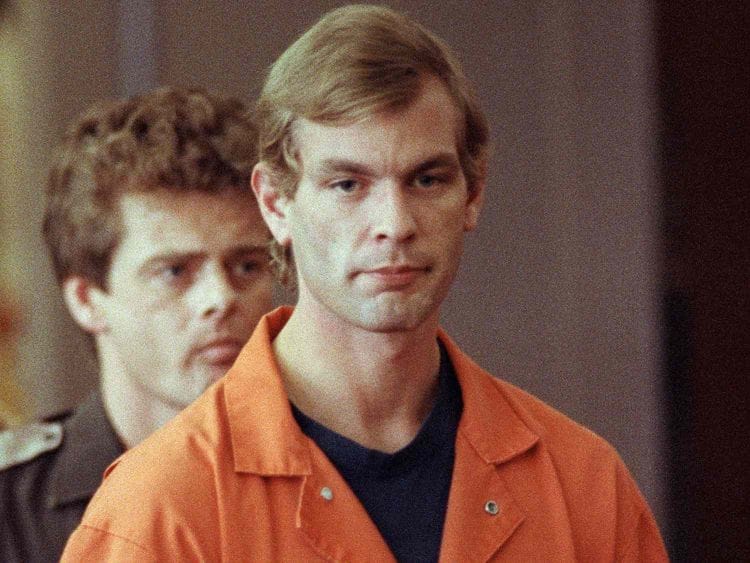
Jeffrey Dahmer
(Milwaukee Cannibal)
Name: Jeffrey Lionel Dahmer
Alias: Milwaukee Cannibal
Body Count: 17
Crime Location:
Status:
Mortality:
Born: May 21, 1960
Milwaukee, Wisconsin, USA
Died: November 28, 1994
Portage, Wisconsin, USA
💀 Manner of Death:
Beaten to death in prison
🧬 Classification
🧠 Mental Profile
🔪 Modus Operandi
🕯️ In Memory
Steven Hicks (18) – June 1978 | Steven Tuomi (24) – September 1987 | James Doxtator (14) – January 1988 | Richard Guerrero (22) – March 1988 | Anthony Sears (24) – March 1989 | Raymond Smith (32) – May 1990 | Edward Smith (27) – June 1990 | Ernest Miller (22) – September 1990 | David Thomas (23) – September 1990 | Curtis Straughter (17) – February 1991 Errol Lindsey (19) – April 1991 | Tony Hughes (31) – May 1991 | Konerak Sinthasomphone (14) – May 1991 | Matt Turner (20) – June 1991 | Jeremiah Weinberger (23) – July 1991 | Oliver Lacy (23) – July 1991 | Joseph Bradehoft (25) – July 1991.
Share this profile
17
Body Count
(victims)
4771
Kill Span
(days)
5
Terror Trail
(locations)
Movies, Documentaries and Docuseries
Watch online through various different streaming platforms and services.

Featured Crime Shows
My Friend Dahmer (2017)
A disturbed childhood, unhealthy obsessions and a liking for alcohol characterise the young life of Jeffrey Dahmer.

Featured Crime Shows
Dahmer Monster: Jeffrey Dahmer Story (2022)
The series examines the gruesome and horrific true crimes of Jeffrey Dahmer and the systemic failures that enabled one of

Featured Crime Shows
Dahmer (2002)
Biopic about notorious American serial killer Jeffrey Dahmer, taking place in both the past and the present.
Content Creators – YouTube

The Disturbing Case of Jeffrey Dahmer
The Disturbing Case of Jeffrey Dahmer is one of the darkest and most unsettling chronicles in American criminal history. This

Inside the Mind of Jeffrey Dahmer: Chilling Jailhouse Interview
Twenty-four years ago, Jeffrey Dahmer was beaten to death in prison while serving 16 life sentences. In 1993, the man


